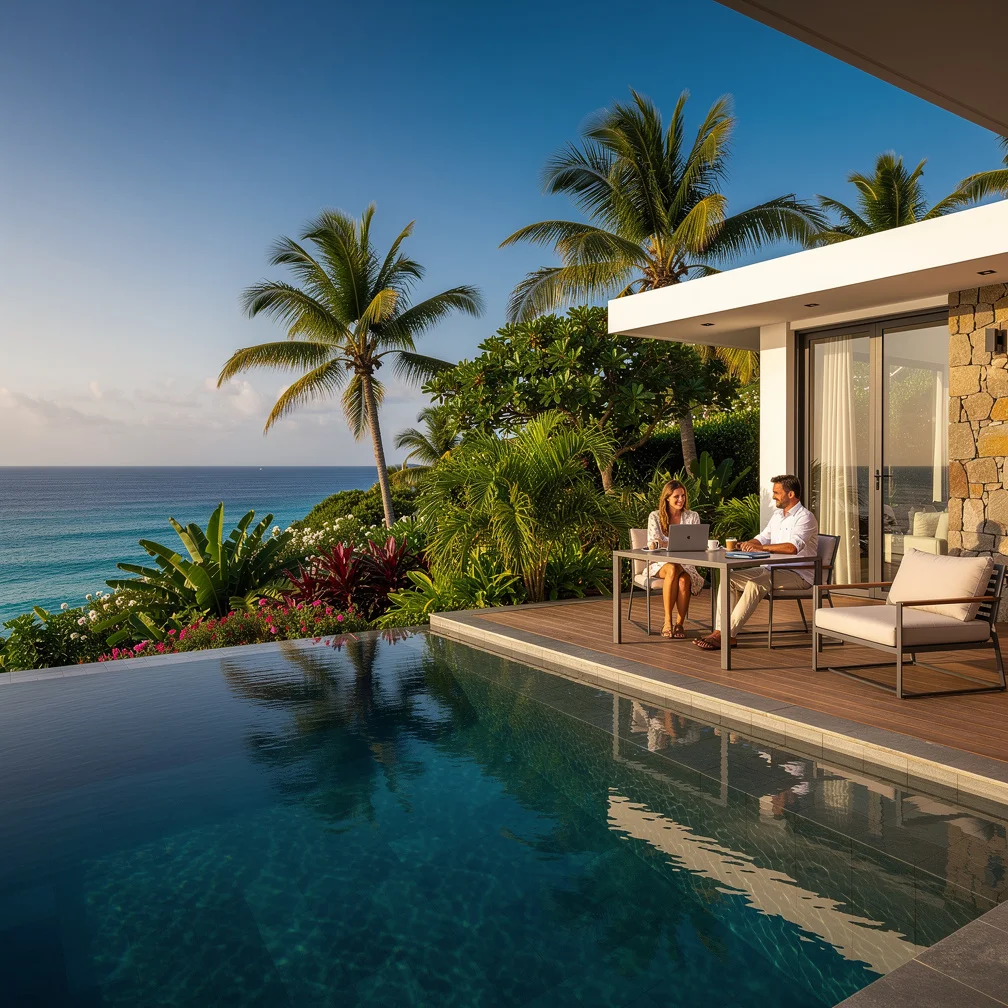
Relocating to Mauritius
A comprehensive guide for entrepreneurs, families and investors — from permit selection and property acquisition to business setup and tax residency in Mauritius.
Mauritius has become a top choice for international entrepreneurs, digital nomads, retirees and high-net-worth families looking for a stable, English-speaking, well-connected island home with a competitive tax environment. The island offers high quality of life, excellent infrastructure, a network of international schools, world-class healthcare and a growing expat community of over 25,000 residents. Regulated by the Economic Development Board (EDB) and the Passport and Immigration Office (PIO), Mauritius has developed a structured, efficient and genuinely welcoming residency framework — with multiple pathways depending on your professional profile, income source and long-term objectives. Personal income tax is capped at 15%, there is no capital gains tax, no inheritance tax, no wealth tax and no exchange controls on foreign-currency accounts.
How to relocate to Mauritius: step by step
Permit selection & eligibility review
We review your professional profile, income sources, family situation and long-term objectives to identify the most appropriate permit category. Where multiple routes are available, we model the tax and residency implications of each — including the interaction with your country of origin's exit tax rules or continued treaty obligations.
Company incorporation or contract preparation
For Investor or Self-Employed OP applicants, we incorporate the Mauritius operating company or establish the freelance registration. For Professional OP applicants, we work with your employer on the sponsorship documentation. This step typically runs in parallel with KYC collection.
EDB permit application submission
We compile and submit the full permit application to the EDB (Occupation Permits and Premium Visas are processed through the EDB's online portal). Documents must be certified and, where applicable, apostilled. The EDB processes most applications within 5 to 10 business days for Premium Visas and 4 to 6 weeks for full Occupation Permits.
Arrival, banking & property
On arrival in Mauritius, we assist with opening a personal bank account (required for income transfer reporting under some permits), registering with the Passport and Immigration Office and, if required, searching for rental or purchase property. We can introduce you to licensed real estate agents for IRS, RES or PDS property acquisition if permanent residence via investment is your goal.
Tax residency establishment
We advise on the conditions for becoming a Mauritius tax resident (183-day physical presence rule) and coordinate with your home-country tax advisor on the timing of departure, tax exit procedures and treaty position. Where beneficial, we prepare a Mauritius Tax Residency Certificate (TRC) application to the MRA for use in double tax treaty claims.
Key documents and requirements
- Valid passport with at least 12 months' remaining validity for all family members.
- Recent police clearance certificate (apostilled) from country of residence and nationality for the principal applicant.
- Certified proof of address (utility bill, bank statement) from current country of residence.
- For Investor OP: certificate of incorporation of the Mauritius company, evidence of initial investment, business plan and financial projections.
- For Self-Employed OP: certified professional qualifications, evidence of client contracts, bank statements showing 12 months of income history.
- For Professional OP: letter of engagement from the Mauritius employer confirming role title, salary and start date; employer's business registration documents.
- For Retired Non-Citizen Permit: evidence of pension, investment income or lump-sum funds; bank statements for the prior 12 months.
- For Premium Visa: proof of income or financial resources (bank statements, employment contract with foreign employer, investment portfolio statement).
- Recent colour passport photographs in the format specified by the PIO.
- Medical insurance policy valid in Mauritius for the duration of the permit for all applicants and dependants.
Indicative costs
| Item | Indicative range |
|---|---|
| EDB Occupation Permit application fee (Investor/Self-Employed/Professional) | MUR 5,000 (approx. USD 110) per applicant |
| Premium Visa fee | MUR 1,000 (approx. USD 22) per year |
| Professional fees — permit preparation & submission | USD 1,500 – 3,500 |
| Company incorporation (for Investor OP) | USD 1,500 – 3,000 (one-off) |
| Mauritius Tax Residency Certificate (MRA application) | USD 500 – 1,000 |
Main residence permit options
Occupation Permit — Investor
Designed for individuals who incorporate and actively operate a business in Mauritius. The minimum investment threshold for most sectors is MUR 375,000 (approximately USD 8,500) in the first year of operation, with the company generating a minimum annual turnover of MUR 3 million (approximately USD 68,000) from year two onwards. The permit is valid for up to ten years and is renewable. Holders can include their spouse and dependent children on a dependent pass. This route suits entrepreneurs who genuinely wish to operate locally — in consulting, financial services, hospitality, agribusiness or technology — and benefit from treaty access and the domestic corporate tax rate.
Occupation Permit — Professional
For salaried employees of Mauritius companies. Requires a minimum monthly basic salary of MUR 60,000 (approximately USD 1,350) for most sectors, or MUR 30,000 for ICT professionals. The employer must demonstrate that the role cannot be filled locally. Valid for up to three years and renewable. This permit is the standard route for executives, fund managers, compliance officers and technology specialists relocating to work for an FSC-licensed or EDB-accredited employer in Mauritius.
Occupation Permit — Self-Employed
For freelancers, consultants and sole traders earning foreign-sourced income while resident in Mauritius. The applicant must demonstrate professional qualifications relevant to their field and show evidence of existing client contracts or income. Minimum annual income of MUR 600,000 (approximately USD 13,500) must be transferred into a Mauritius bank account annually. Valid for up to three years and renewable, with a pathway to permanent residence after three consecutive years. Popular with digital professionals, architects, lawyers advising offshore clients and creative practitioners.
Premium Visa
A one-year visa (renewable indefinitely) for remote workers and individuals with sufficient foreign-sourced passive or employment income who wish to live in Mauritius without establishing a local business. There is no minimum income threshold specified in law, but applicants must demonstrate financial self-sufficiency. No local business activity is permitted. The Premium Visa is processed quickly (often within days) and is the simplest entry route for digital nomads, portfolio investors and those evaluating long-term relocation before committing to a full permit.
Retired Non-Citizen Permit
For individuals aged 50 and above who wish to retire permanently in Mauritius. Requires a minimum transfer of USD 1,500 per month (or a lump-sum equivalent) from abroad into a Mauritius bank account. No professional activity is permitted. Valid for three years and renewable. A straightforward, low-cost route to residency for retirees attracted by Mauritius's climate, healthcare, safety record and absence of inheritance tax — a strong estate planning consideration for wealthy individuals domiciled in high-tax jurisdictions.
Permanent Residence Permit (PRP)
Available to Occupation Permit holders and Retired Non-Citizen Permit holders after three consecutive years of uninterrupted residence. The PRP is valid for 20 years and removes the need for annual or triennial renewal. Investors who acquire residential property in Mauritius under the IRS, RES, PDS or Smart City schemes for a minimum of USD 375,000 may be eligible for a residence permit linked to their investment, without the income or employment requirements of the standard OP routes.